Analyst consensus sets Micron’s 12-month target price around $197, driven by AI-fueled chip demand, strong quarterly performance, and bullish growth forecasts; major brokerage targets now range up to $220, reflecting industry leadership in memory solutions.
Fundamental valuation models (such as discounted cash flow and fair value based on long-term earnings growth) suggest a much lower fair value, between $83–$160, highlighting potential downside if sector momentum slows or capital expenditures do not yield sustained returns.
Micron’s rally is supported by robust Q4 2025 results and upgraded analyst outlooks, but rising competition and elevated market pricing introduce caution; upside depends on maintaining AI-driven growth and margin expansion in a dynamic semiconductor environment.
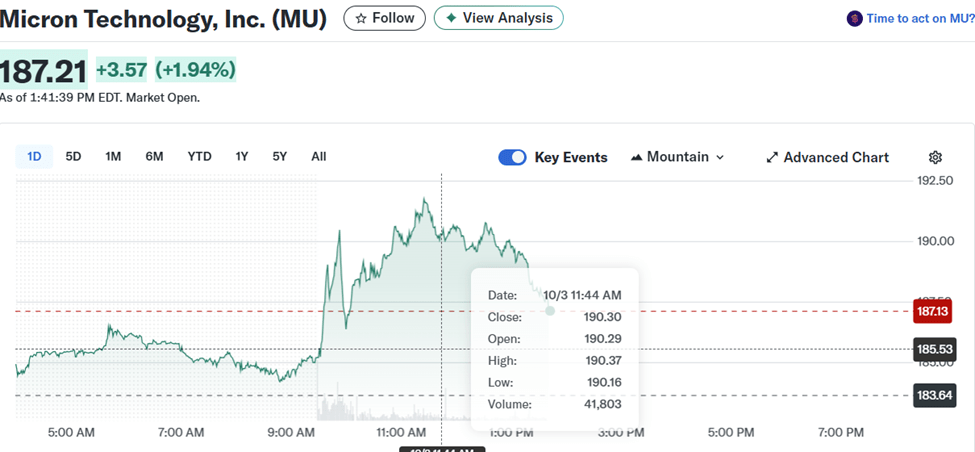
Source: Yahoo Finance
Micron Technology (NASDAQ:MU) has just wrapped up a blockbuster fiscal 2025 with record earnings, surging demand from artificial intelligence (AI) customers, and a stock price rally that has outperformed most tech peers. But after this meteoric rise, investors are asking: Does Micron still present strong value, or are there cracks appearing beneath the optimism?
Recap: Q4 and Annual Results
Micron delivered soaring fiscal Q4 2025 results, posting $11.32 billion in quarterly revenue, up from $9.30 billion in the prior quarter and $7.75 billion a year earlier. GAAP net income reached $3.20 billion ($2.83 EPS), with non-GAAP metrics showing $3.47 billion ($3.03 EPS). For the full year, revenue hit $37.38 billion—a 49% jump over fiscal 2024—while net income reached $8.54 billion (GAAP) and $9.47 billion (non-GAAP). Margins expanded, especially in cloud-related memory where gross margin topped 59%. The company also generated $17.53 billion in operating cash flow, more than doubling the prior year.
Micron’s capital expenditures soared to $13.80 billion in 2025 as the company raced to meet explosive demand for high-bandwidth memory (HBM) in AI applications and next-generation data centers. HBM revenues in Q4 were close to $2 billion, putting the annualized run rate at $8 billion.
Investment Narrative: The AI Catalyst
Micron’s fortunes have become tightly linked with the AI and data economy. AI systems require massive amounts of ultra-fast memory, and Micron is now the only U.S.-based supplier with scale in HBM and DRAM technology. Its memory products for AI generated $10 billion in revenue in fiscal 2025—a more than fivefold increase year-over-year. This is behind the aggressive analyst upgrades, with Deutsche Bank and Piper Sandler raising price targets to $200 and beyond.
The company’s ongoing guidance is robust: management projects Q1 2026 revenue of $12.5 billion (± $300 million) and gross margins of over 50%. Forecasts for fiscal 2028 anticipate $53.6 billion in revenue and $13.6 billion in earnings, underpinned by a forecasted annual growth rate of 16.6%.
Valuation: Is It Still an Opportunity?
Despite the sustained rally, Micron’s valuation looks attractive by sector standards. The fair value estimate for the stock is around $159.91, which currently represents a potential 13% downside from recent market pricing near $182. However, most brokerages maintain a consensus “Buy” rating, with an average one-year price target of $184.77 and continued optimism for outsized earnings growth. The company now pays a modest dividend of $0.115 per share, adding an income component to its growth profile.
Yellow Flags and Risks
Intensifying Competition: Korean and Chinese competitors are ramping up their own advanced memory offerings, threatening Micron’s leadership especially if pricing moves lower or oversupply develops.
Capital Intensity: The company’s rapidly rising capital expenditure could pressure free cash flow if industry demand slackens or pricing power falters.
Valuation Risk: Some analysts warn the stock may have run ahead of fundamentals in the short term, especially if AI-related spending decelerates.
Bottom Line: Hold With Upside On AI Strength
Micron Technology looks well-positioned to benefit from secular demand for AI memory, with best-in-class margins and a solid balance sheet. While the stock’s run has been dramatic and some risks around capex and sector competition are emerging, longer-term investors may find value at current levels, with upside contingent on continued AI growth and sustained earnings momentum. The current analyst consensus is to “Hold” with an upward bias, making MU worth consideration for growth-focused portfolios attentive to semiconductor cycles
 Adithi Pai
Leave a comment